On December 11, 2025, Google rolled out what it called a routine core update. Within 48 hours, publishers across the globe watched their Discover traffic collapse. Not decline, but vanish entirely.
Some sites lost 750,000 impressions overnight. Others saw 90,000 daily clicks drop to zero. One publisher reported a 98% traffic loss before the update was even officially announced.
The December 2025 core update wasn’t just another algorithm tweak. According to NewzDash analysis of over 400 news publishers, web search now sends just 27% of traffic to news sites, down from 51% two years ago. That’s a 24 percentage point collapse.
And here’s what most coverage missed: the traffic didn’t disappear. It moved.
Where Did All That Traffic Go?
While traditional search visibility crumbled, social platforms quietly became discovery engines.
X posts are showing up in Google results more frequently. LinkedIn content is indexing faster. Reddit threads rank for product queries that used to belong to brand websites. YouTube isn’t just a video platform anymore. It’s where people research before buying.
The B2B data confirms the shift:
- 75% of B2B buyers now use social media during purchase decisions
- 80% of B2B social leads come from LinkedIn alone
- 89% of buyers research online before talking to sales and increasingly, that research happens on social platforms, not Google
This isn’t a prediction. It’s already happening.
The Real Problem With “SEO Strategy” in 2026
Most companies are still playing a game that ended two years ago.
They’re optimizing for keywords. Building backlinks. Publishing blog posts nobody reads. Meanwhile, their competitors are building audiences on LinkedIn, showing up in AI-generated answers, and getting discovered through platforms that didn’t exist in their strategy deck.
Google’s December update didn’t just punish low-quality content. It accelerated a shift that was already underway: search is fragmenting across platforms, and visibility in only one place means invisibility everywhere else.
Think about how people actually find things now:
- Quick product comparisons? Reddit or YouTube
- Industry insights? LinkedIn posts from trusted voices
- Breaking news? X, not Google News
- Technical tutorials? YouTube or Stack Overflow threads in search results
Google isn’t the front door anymore. It’s one of many doors and sometimes not even the main one.
What Actually Works Now: The Multi-Surface Playbook
Here’s what’s moving the needle across fintech, SaaS, and e-commerce:
LinkedIn: Still Underrated for B2B
Everyone knows LinkedIn is important. Few companies actually use it well.
The stat that should wake you up: 84% of B2B marketers say LinkedIn delivers the best value of any platform. And 55% of decision-makers use thought leadership content as part of their vendor evaluation.
That means executive LinkedIn presence isn’t vanity. It’s pipeline.
What’s working:
- Personal posts from executives outperform company page content 3:1
- Carousels and document posts get significantly higher engagement than link posts
- Commenting on others’ content builds visibility faster than publishing alone
If your social strategy is “post company blog links to the company page,” you’re leaving money on the table.
Video: The Format You Can’t Fake Anymore
Video content gets 10x more engagement than text. YouTube Shorts has a 5.91% engagement rate, higher than any other short-form platform.
But here’s the real insight: video is becoming essential for AI visibility.
AI systems like ChatGPT and Perplexity increasingly reference YouTube content when answering questions. No video presence means missing social engagement and AI citations.
Start simple:
- Turn top blog posts into 3-5 minute explainer videos
- Use YouTube’s chapter feature for better discoverability
- Repurpose video clips across LinkedIn, X, and Threads
Reddit: The Hidden Conversion Engine
Most B2B companies ignore Reddit completely. That’s a mistake.
Reddit traffic converts better than general social traffic because users have high intent. They’re actively researching, asking questions, seeking recommendations.
Over 100,000 active subreddits cover everything from enterprise software to niche finance topics. Technical subreddits often rank on page one of Google for industry queries.
The approach that works:
- Add value first, sell never
- Answer questions thoroughly. Redditors hate shallow responses
- Build karma before posting original content
AI Search: The New Frontier
Here’s the number that matters: AI bots now account for roughly 33% of organic search activity.
ChatGPT, Perplexity, Google’s AI Mode… These aren’t future considerations. They’re current traffic sources. And optimizing for them requires different thinking than traditional SEO.
What gets cited by AI:
- Clear, structured content that’s easy for models to parse
- Original research and data that AI can reference as authoritative
- Strong E-E-A-T signals, real expertise from real people
- Cross-platform presence, AI models weight information appearing across multiple credible sources
Existing only on your website gives AI fewer signals to trust you.
The Content Workflow That Actually Scales
Here’s the practical framework:
Weekly cycle:
- Create one substantial piece — blog post, report, or analysis
- Adapt for LinkedIn — pull 3-5 key insights into native posts or carousels
- Produce video — even a 2-minute talking-head summary works
- Fragment for X and Threads — single insights with strong hooks
- Engage communities — share expertise in relevant Reddit and LinkedIn discussions
Monthly focus:
- Analyze which platforms drive actual conversions, not just traffic
- Identify content gaps using competitor analysis tools
- Update top-performing content based on search console data
Quarterly review:
- Assess AI citation presence for key queries
- Audit multi-platform brand consistency
- Adjust resource allocation based on performance
Why Manual Cross-Posting Doesn’t Scale
Manually reformatting content for each platform takes forever, quality varies, and things slip through the cracks.
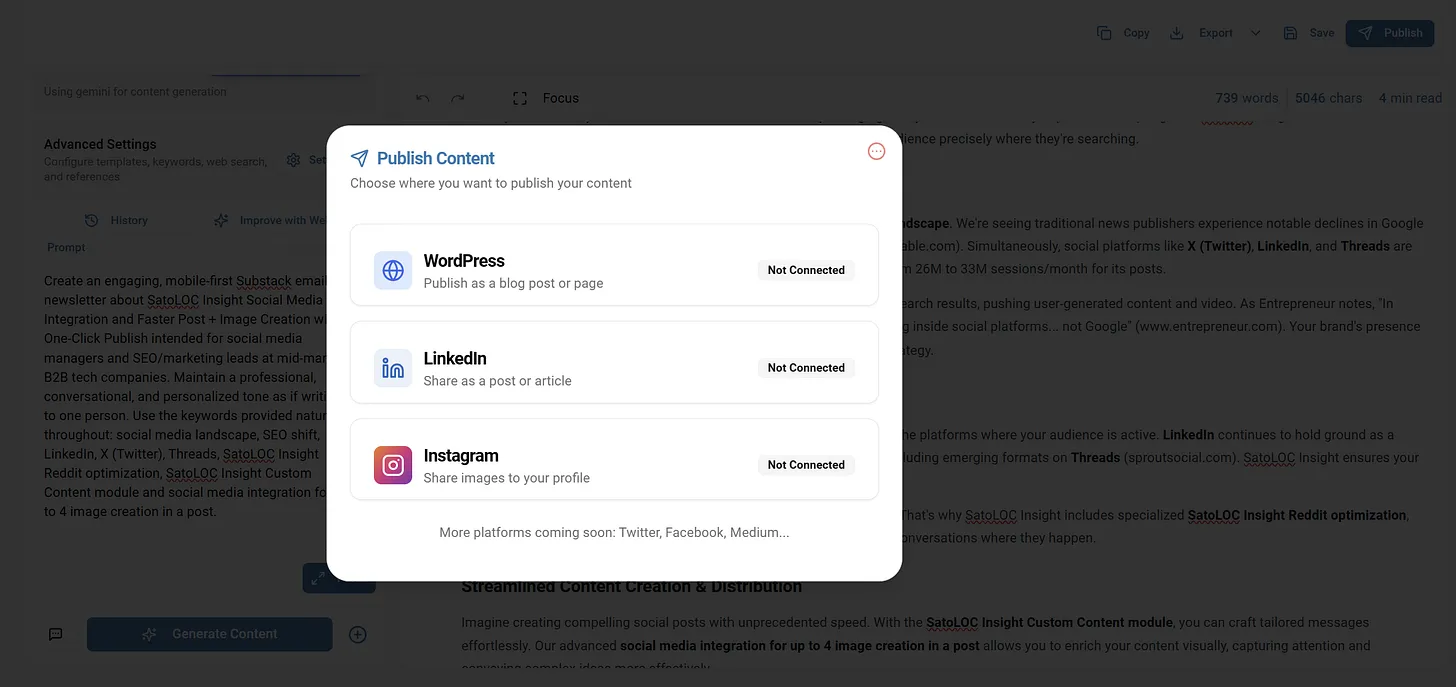
This is exactly why the Custom Content module in SatoLOC Insight exists. One piece of content becomes multiple platform-optimized versions—LinkedIn, X, Threads—with consistent brand voice and SEO optimization built in.
The platform also handles what most tools miss:
- Up to 4 images per post for visual-first platforms
- One-click publishing across all target channels
- Integration with Google Search Console data for performance-informed content decisions
- Multilingual SEO insights for global content strategies
It’s not about replacing human creativity. It’s about removing the friction that stops good content from reaching every platform it should.
The Uncomfortable Truth About 2026
The companies winning right now aren’t the ones with the biggest SEO budgets. They’re the ones who stopped treating social as a side project.
Google’s algorithms will keep changing. Three major core updates hit in 2025 alone. Betting everything on one channel—especially one you don’t control—is increasingly risky.
The data points in one direction:
- Marketing budgets are shifting nearly 12% toward digital channels in 2026
- 45% of marketers are increasing investment in AI-powered tools
- Multi-platform content strategies are becoming baseline, not advantage
The question isn’t whether to diversify. It’s how fast you can move.
What To Do This Week
Three things you can do immediately:
- Audit your current platform presence. Where does your brand actually show up when someone searches key topics? Check LinkedIn, YouTube, and Reddit, not just Google.
- Identify highest-performing content. What blog posts drive the most conversions? Those are the first candidates for multi-platform repurposing.
- Test the workflow. Take one piece of content and manually adapt it for three platforms. Time it. Note the friction points. Then decide whether that’s sustainable.
Ready to skip straight to the scalable version? Book a demo of SatoLOC Insight and see how the workflow actually works.
The search landscape is fragmenting. Your content strategy should fragment with it.
Leave a Reply