
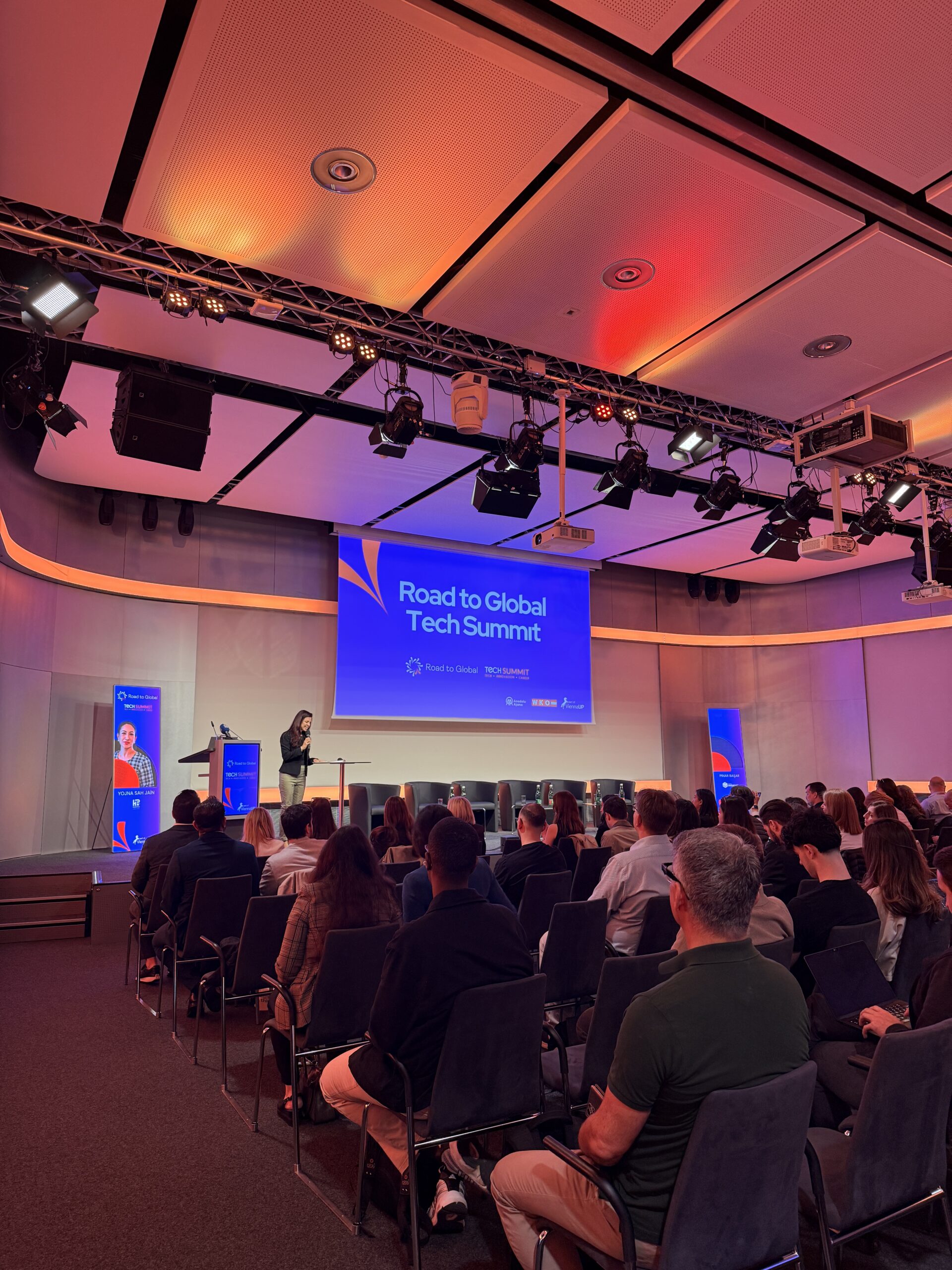
In May 2026, Vienna became the backdrop for a different kind of exchange: the high-stakes work of taking a product international. Standing on the ViennaUp 2026 stage as part of the Road to Global Shining Stars showcase, I had five minutes to explain how SatoLOC Insight is rethinking what a global content operation actually looks like.
For a founder, a pitch is never just about the product. It is about the version of the world you are trying to build. For us, that world is one where local nuance and global reach stop being a trade-off. This is what we took to Vienna, what resonated, and what we learned.
Why the Road to Global starts in Vienna
Vienna sits at the seam between Western and Central Europe, which makes it a serious testing ground for any company claiming to be “global.” ViennaUp 2026 brought together investors, operators, and founders focused on one shared question: how do you scale across markets without flattening what made the product good in the first place?
The Road to Global initiative is built for companies past the idea phase, working through the real complications of expansion. Europe is a hard place to fake localization. Dozens of languages, distinct cultural codes, and tightly held data rules sit inside a single continent. A one-size-fits-all content strategy does not survive contact with this market.
What stood out in the room was the shift in the conversation. People weren’t asking about content. They were asking about brand integrity across borders, and how to keep a consistent voice when content is being produced and adapted at speed.
The pitch: a local workspace for global content
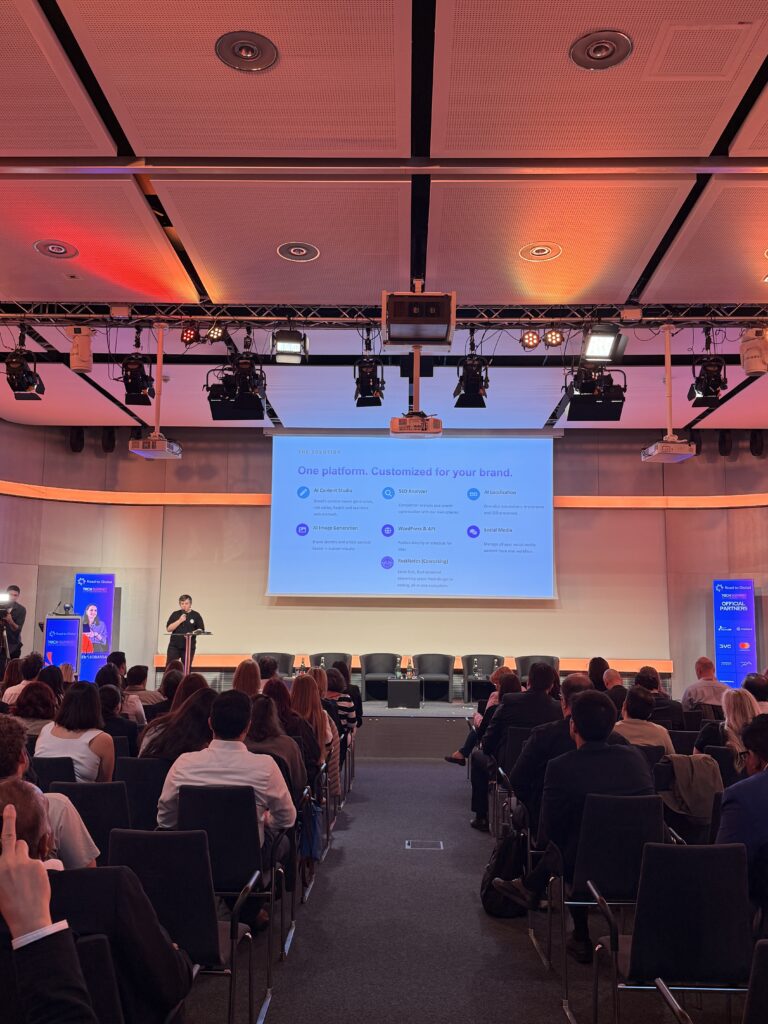
The pitch was built around moving the conversation away from translation and content tools and toward something closer to global content infrastructure. Three ideas did most of the work.
Context over literal translation and content generation. Most tools can translate words. Fewer can carry intent across a language. SatoLOC Insight uses retrieval-augmented generation so content stays relevant, not just linguistically correct.
The local workspace. This was the part of the pitch that landed hardest. A local workspace is a hub where global strategy and local execution sit side by side, so distributed teams can run regional campaigns without losing the thread of the brand.
SEO and GEO together. Ranking on Google is no longer the full job. Visibility inside generative and answer engines now matters just as much. The platform is built to optimize for how people actually search in 2026, not just how they searched five years ago.
Visuals that carry the brand. Text is only half the job. Most stacks force teams to generate copy in one tool and visuals in another, and the brand identity gets lost in the handoff. The Design Studio sits inside the same workspace as the content editor, with AI imagery and automatic logo overlay built into the flow. A campaign visual ships looking like it belongs to your brand, not like a generic AI image with your logo bolted on afterward.
As we have written before in our analysis of why SEO still matters in the age of AI, the work has shifted. Content is no longer judged only on keywords. It is judged on whether it can be the authoritative answer, in any language a customer happens to ask in.
Beyond generic LLMs
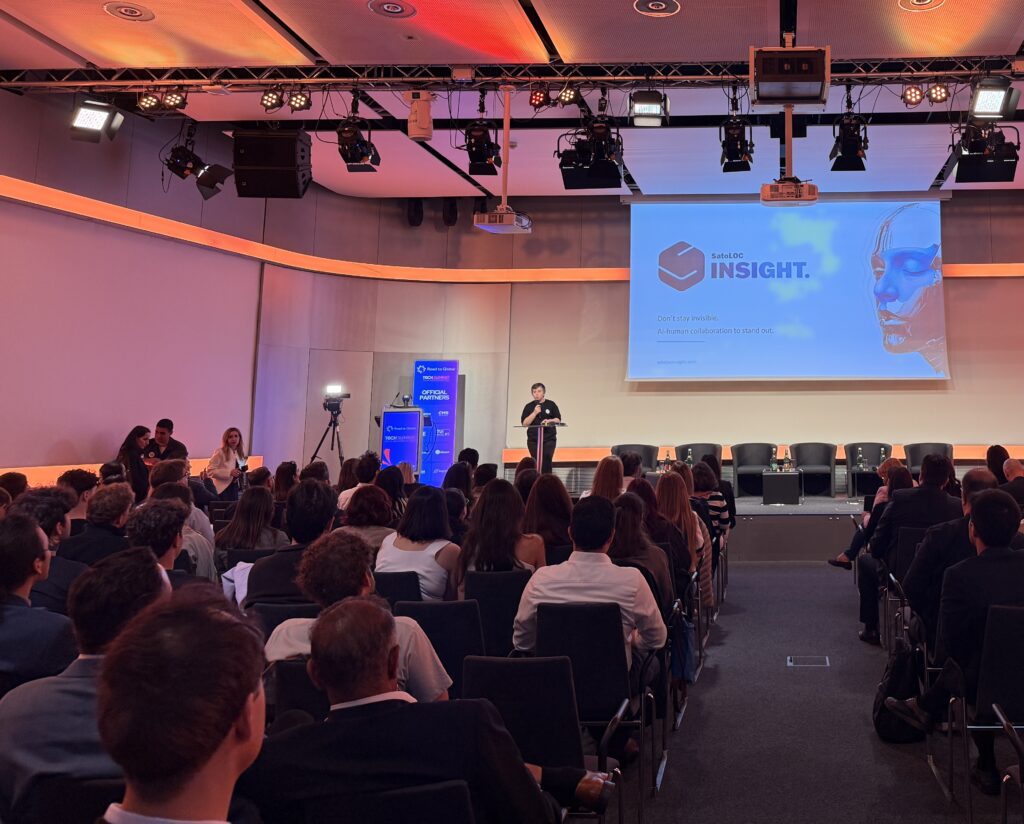
One question came up more than any other on the panel: how is this different from just using a top-tier LLM directly?
The answer is architectural. General-purpose models are powerful, but they treat brand voice, regional context, and proprietary data as inputs to be guessed at, not as structured knowledge to be respected. SatoLOC Insight is built around a specialized framework that brings those elements in safely — something we go deeper on in our piece on RAG and global SEO.
This also extends to visual identity, which is where most AI content workflows quietly fall apart. Generic models can produce an image, but they cannot hold your brand. Inside SatoLOC Insight, visuals are generated with brand context already in place — palette, mood, and logo overlay applied automatically as part of the editor workflow, not as a separate export-and-fix step in another tool.
| General-purpose LLMs | SatoLOC Insight | |
|---|---|---|
| Cultural nuance | Averaged across the training data | Held inside dedicated local workspaces |
| SEO and GEO optimization | Requires manual prompting | Built into the generation flow |
| Brand voice | Reset every session | Persistent across the workspace |
| Visual identity | Generic outputs, manual brand fixes | Brand-aware imagery with automatic logo overlay in-editor |
| Workflow | Single-step generation | Full content lifecycle in one place |
The point we wanted to leave with the room was that SatoLOC is not a wrapper. It is the infrastructure a company needs when multilingual content stops being a side project and becomes core to how it grows.
One ecosystem, not five subscriptions
The other thread that came through repeatedly in Vienna was fatigue. Founders and operators are tired of paying for a chat tool, a docs tool, a design tool, a project tracker, and a separate AI seat to ship a single piece of work. Last week we wrote about the hidden cost of using five tools to do one job — and that argument played out almost word-for-word in the conversations we had at the event.
This is also why SatoLOC Insight is being built as an ecosystem rather than a single product. Alongside the content and localization platform, we are introducing a local-first workspace that replaces the usual sprawl of project tracking, chat, docs, design, notes, and editor tools — in one calm surface, under the same ecosystem. The intent is the same in both directions: fewer tools, more context, work that stays connected to the brand instead of being scattered across tabs.
Notes from the founder’s notebook
A few things from Vienna worth carrying forward, for any founder thinking about their own global push.
Know the local pain points. In Europe, GDPR and linguistic diversity are not features you add on. They are the floor. Pitching to that floor builds trust faster than any growth chart.
Show the workflow, not the output. We demoed how a single English campaign adapts to the DACH region in seconds, preserving the specific feel of each market. The reaction was to the process, not the result.
Pitch the workspace, not the tool. “Workspace” implies a way of working. People bought into that framing more than any individual feature.
Be honest about where you are. The market is tired of polished narratives. A clear “here is what works, here is what we are still building” lands better than a perfect story.
The road to global is paved with local insights. If you cannot speak to a customer in their cultural context, you are not really speaking to them at all.
What comes after Vienna
The direction from here is clear. Demand for high-quality content is climbing as new markets come online and AI changes how people consume information. Our job is to stay close to that shift and make it easier for brands to keep up.
The feedback from Road to Global confirmed something we already suspected: the market is not looking for more automation. It is looking for intelligence — tools that understand a marketing message in Vienna needs a different weight than one in Dubai or Tokyo, even when the product is identical.
Your next step
Vienna was a milestone, not a finish line. For founders and marketing leaders, the takeaway is straightforward: the world is ready for your product, but only on its own terms. Localization and content marketing are no longer a luxury. They are the baseline for international survival.
If you want to see what a local workspace can do for your global content operation, the easiest way is to try it. Start your 7-day free trial at satolocinsight.com and see how the workflow holds up against your real campaigns.
Leave a Reply