
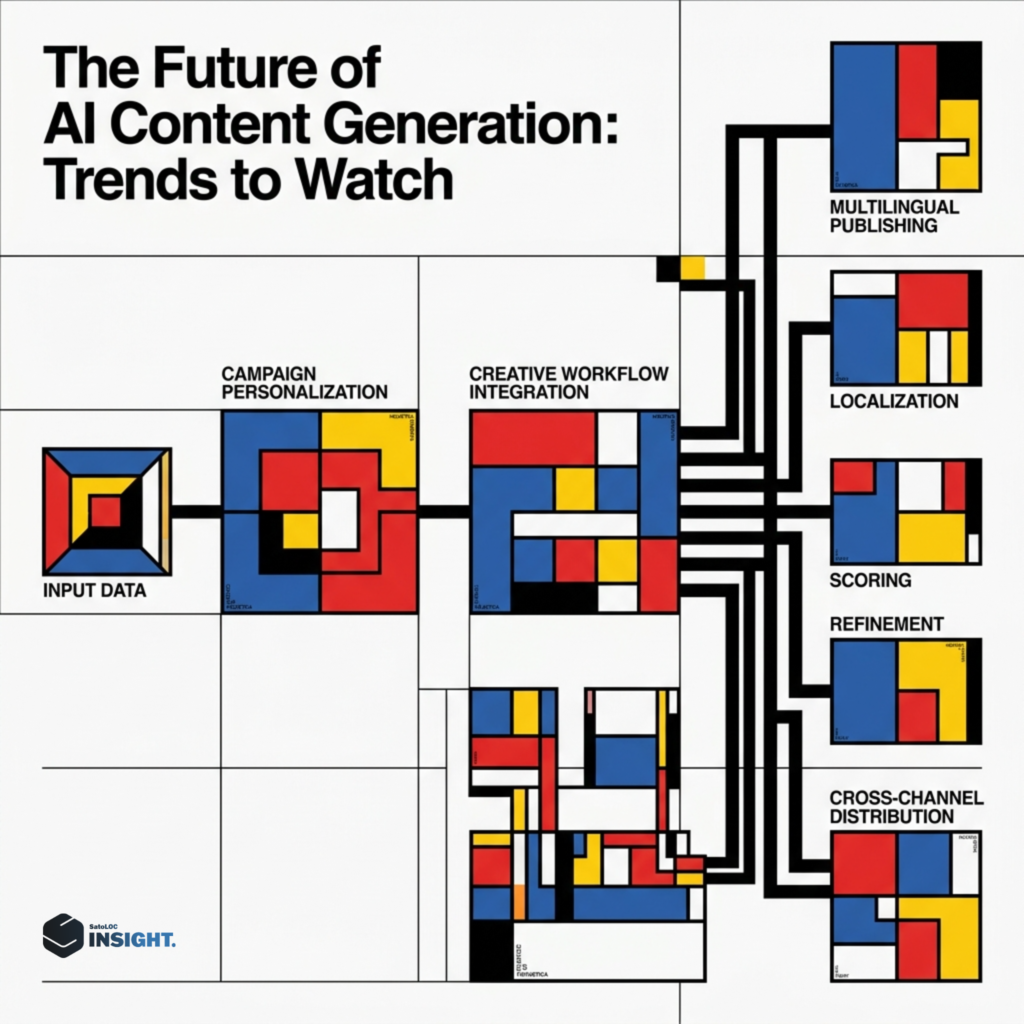
AI content generation is moving past the “write me a blog post” phase. The next wave is about systems that can personalize, localize, score, and refine content across channels while staying closer to brand rules and business goals.
TL;DR: Summary
- AI content generation is shifting from simple drafting to scaled, personalized, multi-format production. The strongest near-term trends are campaign personalization, creative workflow integration, multilingual publishing, and AI agents that learn a team’s style.
- Text remains the dominant use case, but image and code generation are already meaningful secondary formats. McKinsey reported that 63% of organizations regularly using gen AI create text outputs, more than one-third generate images, and more than one-quarter create code.
- Personalization is becoming the biggest value driver. Nielsen’s 2025 global marketing survey found 59% of marketers see AI for campaign personalization and optimization as the most impactful trend, while 47% already use AI for content creation.
- The operational winners will combine generation with QA, SEO, analytics, and distribution. Generic writing tools help with ideation, but global teams usually need workflow controls, brand-tone consistency, CMS integrations, and multilingual performance tracking.
- Human roles are not disappearing. They are shifting toward editorial direction, source control, compliance review, prompt and system design, and model oversight, especially for high-risk or high-visibility content.
The future of AI content generation is less about one model being “smarter” and more about whether teams can turn output into repeatable publishing operations. That is why the most useful signals now come from adoption data, workflow design, and the rise of tools that connect content generation with localization, SEO, and measurement.
What is changing in AI content generation right now?
AI content generation is moving from isolated drafting to connected production systems. Nielsen, Gartner, and McKinsey all point to a market where creation, personalization, and workflow adoption are converging.
A year ago, many teams treated generative AI as a fast first-draft assistant. That use case still matters, but the center of gravity has shifted. Nielsen found that 47% of companies use AI for content creation, while 42% use it for personalization and 44% use it for customer segmentation. That matters because content gets more valuable when it adapts to audience context instead of staying generic.
Gartner’s 2025 data adds a second signal: among organizations that adopted GenAI, 77% use it for creative development tasks. In other words, adoption is no longer just about saving writing time. It is about fitting AI into campaign planning, message testing, and asset production.
A common misconception is that the future belongs to fully autonomous content factories. The stronger pattern is controlled automation, where humans set goals, approve inputs, and monitor outcomes while AI handles repetition, versioning, and scale.
Why is personalization becoming the core AI content generation trend?
Personalization is becoming the main trend because it ties content directly to revenue outcomes. Nielsen’s 59% finding on campaign personalization and optimization is the clearest market signal.
Generic content is cheap to produce and easy to ignore. Personalized content is harder to build manually, which is exactly where AI has a structural advantage. If a team needs 50 audience variants, 12 country versions, or channel-specific rewrites for email, paid social, landing pages, and product pages, AI can reduce the production burden dramatically.
This is also why segmentation and content generation are starting to merge. If AI can help define audience clusters, predict message fit, and produce tailored copy from the same workflow, marketers get a tighter feedback loop. That is more useful than a chatbot that simply rewrites a paragraph.
Pro tip: personalization is not just inserting a first name or swapping a city. Real personalization changes examples, offers, tone, intent match, and keyword targeting based on audience segment and market.
What AI content generation platforms are shaping multilingual marketing workflows?
The most influential platforms combine generation with brand control, creative tooling, or operational delivery. The market is splitting into general models, creative suites, and workflow platforms.
Teams evaluating the future should watch platforms by category, not by hype cycle alone. A strong stack often includes one system for general ideation, one for brand governance or creative production, and one for localization or performance monitoring.
- SatoLOC Insight: A beta AI-powered platform that combines localization, multilingual SEO, content analytics, and content creation, with live SEO tracking and integrations for WordPress, custom CMS setups, and a REST API.
- OpenAI / ChatGPT Enterprise: Useful for general drafting, summarization, ideation, and reusable prompt workflows across many content teams.
- Adobe Firefly and Adobe’s creative stack: Strong for image-centered creative generative AI and for teams that need brand-aware visual production.
- Writer or Jasper: Common examples for enterprise brand governance, templates, and team-level writing operations.
- Localization platforms with AI layers: Useful when multilingual publishing, terminology control, and translation workflow matter as much as content generation itself.
If your core problem is ideation, a general model may be enough. If your core problem is multilingual publishing across web properties, workflow and QA matter more than raw model fluency.
How does AI content generation compare with traditional content production?
AI content generation is faster and more variable, while traditional production is slower and often more consistent at the first-pass editorial level. The trade-off is speed versus control, not speed versus quality.
Traditional workflows rely on people to research, draft, edit, localize, and publish sequentially. That works well for flagship content and regulated material, but it does not scale well when teams need dozens of variations. AI reduces time spent on repetition, especially for derivative assets like meta descriptions, ad variants, summaries, and market-specific rewrites.
The catch is that faster drafting does not always mean faster publishing. If AI output creates more review work because the prompt, source data, or brand rules were weak, total cycle time can actually rise. This is where process design matters.
SatoLOC Insight is a useful example of where the market is heading because it connects content creation with localization, SEO, content analytics, and publishing integrations rather than treating generation as a standalone task.
“SatoLOC Insight combines localization, SEO, content analytics, and content creation in one beta AI-powered platform.”
How should teams build an AI content generation workflow that scales?
Scalable AI content workflows start with source control, not prompts. Gartner and Nielsen data suggest the highest-value systems connect content generation to campaign operations and personalization.
Step 1 is to define the source layer. That means approved product facts, positioning, audience segments, style guidance, legal constraints, and SEO targets. A common misconception is that better prompts alone fix weak source data. They do not. If the source is inconsistent, the output will scale inconsistency.
Step 2 is to convert brand knowledge into reusable workflow inputs. That can include tone rules, approved claims, glossary terms, examples of strong writing, and content templates by channel. This is also where localization teams should add terminology and market preferences so the system does not produce literal but awkward regional variants.
Step 3 is to connect generation to distribution and measurement. If a team publishes in WordPress, a custom CMS, or via API, the AI layer should fit that path. If it does not, people fall back to copy-paste work, and the workflow stalls before value shows up.
SatoLOC Insight’s setup reflects this broader direction because it supports WordPress, custom CMS environments, and a REST API instead of forcing teams into a closed content island.
“SatoLOC Insight integrates with WordPress, custom CMS setups, and a REST API.”
Which content formats will grow fastest beyond text?
Image and code generation are the clearest next-growth formats. McKinsey’s 2025 findings show text still leads, but more than one-third of organizations generate images and more than one-quarter generate code.
That mix matters because marketing content is already multi-format. A landing page is not just copy. It includes visuals, metadata, structured blocks, experiments, tracking logic, and sometimes interactive components. As models improve, teams will expect one workflow to produce coordinated asset sets rather than isolated pieces.
The most practical expansion areas look like this:
- Image generation: Campaign concepts, social visuals, ad variations, and localized creative refreshes.
- Code generation: Templates, lightweight page components, QA scripts, and workflow automation.
- Structured text outputs: Product descriptions, FAQ blocks, schema-ready snippets, and metadata at scale.
Pro tip: the winning use cases are not always the flashiest ones. Many teams get faster ROI from structured outputs and repetitive variants than from fully original long-form content.
How do generic AI writing tools compare with integrated SEO and localization platforms?
Generic writing tools are strong at ideation and drafting, while integrated platforms are stronger at operational publishing. OpenAI and Adobe help create; workflow platforms help govern, localize, and measure.
If your team mainly needs brainstorming, article outlines, and quick rewrites, a general-purpose model may cover most needs. If your team runs multilingual websites, market-specific pages, and ongoing SEO reporting, the requirements change. You need content generation tied to URLs, metadata, language variants, QA, and performance data.
This is where integrated systems have an advantage. They can reduce manual handoffs between copywriting, localization, SEO, and web operations. That matters because each handoff creates delay, formatting drift, or lost context.
SatoLOC Insight fits that integrated category by pairing content generation with live SEO performance tracking and AI-powered optimization recommendations.
“SatoLOC Insight supports live SEO performance tracking and AI-powered recommendations for optimization.”
How can you evaluate AI content quality before publishing?
Reliable evaluation starts with editorial checks, then moves to brand and performance validation. Nielsen’s numbers on personalization matter here because the wrong personalized output can fail quietly at scale.
Step 1 is factual review. Check names, product details, dates, statistics, legal claims, and source references. This is non-negotiable for product, medical, financial, or policy-sensitive content. If the input includes uncertain facts, the output should be treated as unverified by default.
Step 2 is linguistic and brand review. Look for tone mismatch, awkward translation, repeated phrasing, and low-intent keyword stuffing. For multilingual teams, this is where linguistic QA matters. A translation can be grammatically fine and still feel wrong for the market.
Step 3 is live performance review. Measure click-through rate, engagement, ranking movement, conversion behavior, and bounce patterns by page type and language. If one market underperforms, review whether the issue came from keyword mapping, cultural tone, or weak localization rather than the model itself.
Common misconception: grammar quality is not the same as content quality. A fluent paragraph can still be strategically weak, factually unsafe, or irrelevant to search intent.
Will AI agents replace content teams or change their roles?
AI agents will change content roles far more than they will erase them. Adobe’s creator survey suggests strong demand for agent-like systems that learn a person’s style.
Adobe reported that 86% of global creators use creative generative AI and 85% would turn to an AI agent that learns their creative style. That does not point to less need for human judgment. It points to a new operating model where agents handle adaptation, retrieval, drafting, and versioning while people handle narrative direction, approvals, and standards.
In practice, content roles split into three layers. One layer sets strategy and editorial priorities. Another manages systems, prompts, knowledge sources, and governance. A third reviews outputs, especially for brand-sensitive or high-impact material. Teams that make this shift early will move faster without giving up control.
Pro tip: if you want an agent to “learn your style,” give it approved examples, rejection examples, glossary rules, and channel-specific constraints. Style is easier to teach through patterns than abstract adjectives.
How should global teams operationalize multilingual AI content generation?
Global AI content generation works best when localization, SEO, and site structure are handled together. Sitemaps, URL inventories, and language-specific performance data are usually the real starting point.
Step 1 is to identify what actually exists on the site. Many teams underestimate how much value is trapped in old product pages, alt text, metadata, navigation labels, and help content. A crawl-based workflow is often better than manual exports because it captures page structure and hidden content elements.
Step 2 is to map content to local intent. Direct translation is rarely enough for SEO. If a keyword has different commercial meaning in Germany, Japan, or Brazil, then the page brief should change before generation begins. If not, the team may publish fluent pages that never rank or convert.
Step 3 is to monitor by language and page class. A localized blog post, pricing page, and support article need different success metrics. Strong teams watch rankings, traffic quality, conversions, and content gaps per market, then feed those signals back into generation and QA.
This operational view is why sitemap extraction and URL-aware workflows are gaining attention. They reflect how websites actually work, especially for large multilingual estates.
What risks matter most in AI content generation?
The biggest risks are factual error, brand inconsistency, compliance exposure, and low-value scale. The more automated the workflow becomes, the more those risks compound if left unchecked.
The main risk categories are straightforward:
- Factual drift: AI can produce fluent errors, outdated claims, or unsupported statistics.
- Brand inconsistency: Tone, terminology, and message hierarchy can change across teams and languages.
- Search risk: High-volume generic pages can create duplication, cannibalization, or low-intent traffic.
- Localization failure: Literal translation can miss market norms, local keywords, or product context.
- Workflow fragility: Copy-paste publishing and disconnected tools create hidden QA failures.
If the content is high-risk, then human review should stay close to the source and approval layers. If the content is repetitive and low-risk, then automation can go further, as long as performance and QA signals are still monitored. That if-then logic is likely to define the next phase of AI content generation more than any single model release.
Leave a Reply